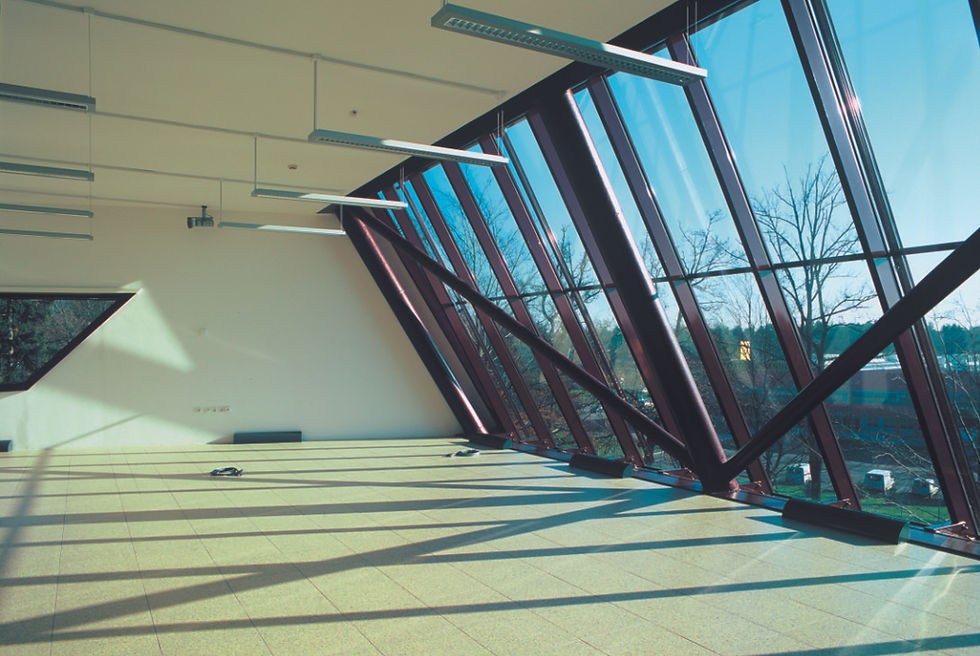
Acman House – Architectural Statement
Updated: Sep 3
Acman residential house is a strong architectural statement that deliberately steps away from conventional contemporary design trends. In doing so, it establishes a distinct and recognizable identity within its spatial and cultural context.
TYPE OF PROJECT: Architectural building / Residential building
LOCATION: Slovenian countryside – Griže next to Žalec
KEY ARCHITECTURAL FEATURES:
_Iconic sculptural presence.
_Postmodern formal expression.
_House as a clear spatial shell.
_Strong contextual impact.
_Exclusivity and programmatic adaptability.

Acman House is a strong architectural statement that deliberately steps away from conventional contemporary design trends. In doing so, it establishes a distinct and recognizable identity within its spatial and cultural context.
While it engages with elements of postmodern expression through a carefully articulated formal language, it ultimately transcends and reinterprets them in a unique, independent architectural voice.

The design by Korpnik understands the house as a powerful architectural sign – open, layered, and semantically rich. Rather than offering a single fixed meaning, it invites interpretation and personal engagement, creating a dynamic relationship between observer, inhabitant, and object.
At its core, the house returns to a fundamental architectural principle: the building as a protective shell that shapes and enables life within. In this sense, it operates as an archetypal form, while simultaneously referencing and reinterpreting architectural tradition within a contemporary framework.


Despite its functional adaptability, Acman House requires a clearly defined and visionary client, as its expressive character is not neutral but intentional and assertive.
In the landscape, it asserts itself as a confident and recognizable object—an architectural presence that actively shapes its surroundings rather than passively fitting into them.
Ultimately, the house functions as a strong spatial and visual marker. It introduces character, identity, and tension into its environment, becoming a meaningful architectural gesture that reflects both contemporary expression and a subtle reference to the passing of time.

Location: Griže pri Žalcu, Slovenia
Year: 1999
Material: Concrete, steel, glass, aluminum
Architect: Nande Korpnik
Project Team: Boris Stropnik, Uroš Trauner.
Engineering: Tomaž Klančnik (Structure), Herman Jelen (facade)
Photo: Miran Kambič
AWARD:
_Plečnik Award 2000,
_Nomination in the national selection for the international European award
Mies van der Rohe for 2000,
_Golden Pencil for excellent realization in 2005.
"THE ICONIC PRESENCE OF ARCHITECTURE IN THE VISUAL LANDSCAPE
We must accept the Acman House as a meaningful message about its independence from contemporary architectural tendencies and views that paradigmatically regulate the edges of its spatial presence. It is not an idea that would stray far from postmodernist expressive cunning, since it uses a refined formal definition, but it is certainly also in conflict with it. Korpnik's building is primarily a sign, so semantically open that we must get used to it and accept it in its intended message.
The architect actually returns to the essential question, the house is a shell and inside it is a living space, therefore it is a primal structure, comparable to images from the architectural tradition and at the same time a memory of it, as early postmodernism clearly established in this function. However, such a house, despite its rational programmatic flexibility, must have an exclusive client, due to its liberated address and its own social stance. The house actually consciously imposes its presence in the visual landscape and acts more like an aggressive sign than anything else, perhaps because of this it contains a hint of the metaphor of the passing century." BERNIK, STANE (2004), SLOVENIAN ARCHITECTURE OF THE TWENTIETH CENTURY, LJUBLJANA, LJUBLJANA CITY GALLERY